Around the new year, it’s common to post a photo of an impressive stack of books—a public signal of ambition or discipline. I want to do something different: highlight books that work especially well together when they’re closely studied.
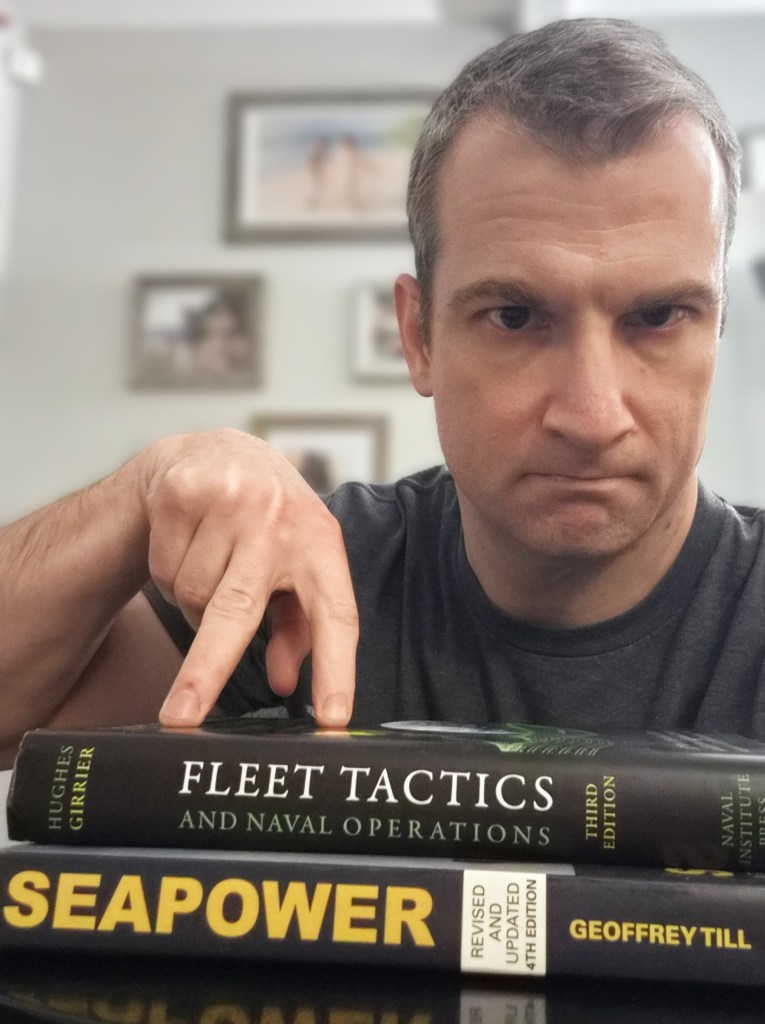
For anyone serious about naval thinking, Seapower by Geoffrey Till and Fleet Tactics by Wayne Hughes and Robert Girrier fall squarely into the “study, don’t skim” category. Both are well known, so this isn’t a review. The point is how they complement each other: Till explains why seapower matters at the strategic level, while Hughes and Girrier dive deeply into how fleets actually fight. Read in sequence, they link strategy to execution in a way few other pairings do.
There’s a ton I could say about either, including their implications on DMO and fleet design, industrial policy, or our current wacky political moment, but instead I’ll just relay some of my highlights:
From Seapower:
“Seapower is clearly a larger concept than landpower or airpower, neither of which encompass the geo‑economic dimensions of human activity to the extent that seapower does.”
“A degree of creative tension amongst the services should be accepted as a means of guarding against the tendency to ‘level down’ to the lowest common denominator between them since the measure of the success of true joint operations is that each service operates more successfully with the others than it could on its own.”
“There will probably always be a tendency to invest in the showier aspects of seapower (glitzy platforms) at the expense of boring things such as ammunition stocks. All experience warns of the dangers of allowing navies to be ‘hollowed‑out’ in this way.”
“The large surface ship may well come to be seen essentially as a mother ship providing a range of manned and unmanned sensors and weapons, command facilities, accommodation and support.”
“Post‑modern navies may get what they need more quickly and more cheaply from foreign suppliers than they could by relying on domestic industry; they may not be particularly bothered by the theoretical strategic vulnerabilities this reliance on an open defense market may open up now or in the future.”
“When a country is afflicted by domestic political discord, its navy, however strong, will tend to fall to pieces.”
“All of these systems of systems involve challenges to the traditional and independent initiative of the local commander since to make sense of it all final authority for the disposition and use of the individual units had to be vested in some central authority, probably ashore. Increasingly, it will be higher authority rather than the commander on the spot who has responsibility for locating the adversary and responding.”
From Fleet Tactics:
“Carl von Clausewitz argued that although good strategy could come from the inspired novice, effective tactics were the work of a lifetime.”
“Poetic imagination is not a quality with which military leaders are heavily endowed; if it were, they might all be mad.”
“To a person, strong military leaders want freedom for initiative from their seniors and reliability from their juniors.”
“The physical speed of ships, aircraft, and weapons can easily be confused with the speed of decision and the speed with which the decision is executed.”
“Often the second-best weapon performs better because the enemy, at great cost in offensive effectiveness, takes extraordinary measures to survive the best weapon.”
“Since the enemy can be expected to know about anything that has been practiced very much, complex fleet tactics must work even when the enemy is aware of them.”
“American scorn for Japanese technology takes much of the blame for the U.S. Navy’s overconfidence at the start of the Pacific war, which was almost as foolhardy as German and Japanese overconfidence in the immunity of their own ciphers.”
“The first aim of every seagoing captain and commander should be to find two officers better than himself or herself and help in every way to prepare them for war. That done, everything else will follow.”
“Cleverness, ingenuity, and complex maneuvers work best for solo performers such as submarines and small units that can be highly trained.”
“The essential foundation of all naval tactics has been to attack effectively by means of superior concentration, and to do so first, either with longer-range weapons, an advantage of maneuver, or shrewd timing based on good scouting.”
“With half the propulsive power a ship can travel about 80 percent as fast.”
“The development of complex tactics in peacetime has been a longstanding predisposition. After the first battle, tactics are usually simplified.”
“In the open ocean, a fighting fleet that is even slightly inferior will usually be defeated decisively by a superior enemy and inflict little damage on him.”
 William C. Spears
Leave a comment