When I began my Navy career as an enlisted nuke electrician, I was relentlessly beaten over the head with the importance of “integrity.” What is integrity? Ask any group of sailors, and they will tell you it is “doing the right thing, even when nobody is looking.”
A few years later, as a midshipman at a little trade school in Annapolis, I was relentlessly beaten over the head with many things, but among them was the importance of “honor.” What is honor? Ask any group of midshipmen, and they will tell you it is “doing the right thing, even when nobody is looking.”
Honor and integrity, then, are often used interchangeably as a gross approximation of “honesty.” And this is a useful heuristic when you’re trying to cram a squishy, liberal-artsy concept in between the sixteen pounds of thermodynamics that need to fit into an eight-pound, twenty-year old brain. But this reduction obscures a deep well of meaning below the surface. There’s a lot of overlap in the Venn diagram, but these words do not mean the same things.
Integrity, for instance, describes a state of being whole and undiminished, whether we’re talking about a ship’s hull or a human being. It represents coherence in thought, word, and deed, and aside from that, is a topic for a different post.
Honor is vastly more slippery. Honor can refer to honesty. Honor can refer to pride. Honor can refer to respect. Honor can refer to external titles and adornments. It can be a noun, verb, adjective, or interjection. Like integrity, it can subsist on individual or collective levels, with heavy implications that tie back to leadership. Don’t even get me started on “honor cultures” versus “dignity cultures.”
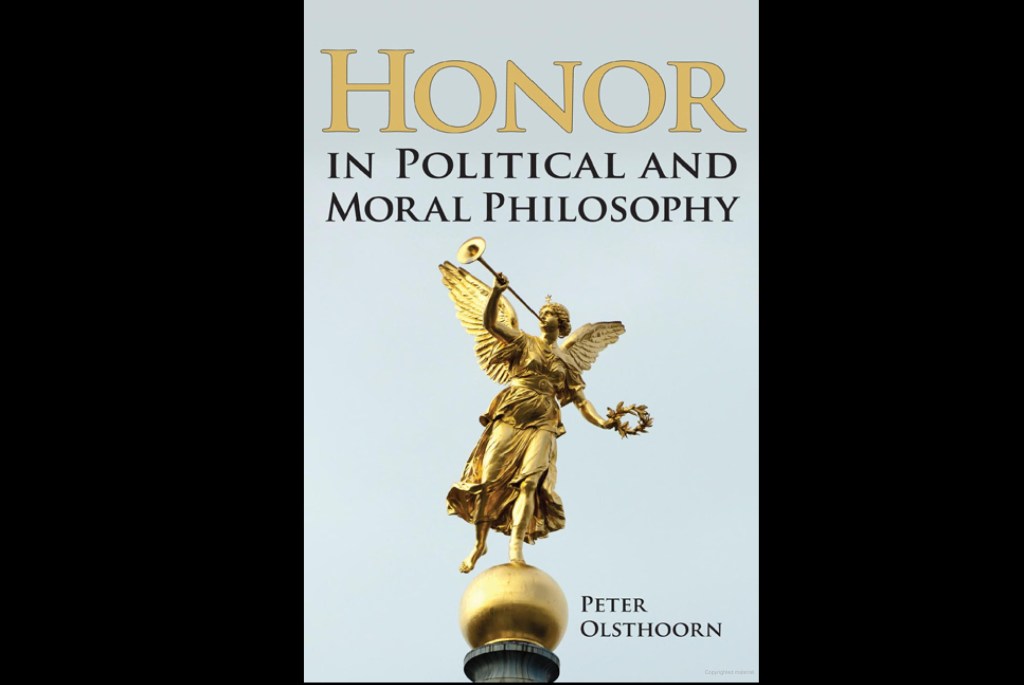
All of this is covered Peter Olsthoorn’s Honor in Political and Moral Philosophy. This is a hidden gem that belongs on every leadership autodidact’s shelf– to be digested cover to cover. It’s also mercifully short, at 160 pages plus notes. Some of my highlights:
Most people can be induced to conform to the rules of justice and even to act for the greater good, although for a motive that is not completely altruistic, when an appeal is made to their honor.
Seneca: Imagining that a Cato or Scipio is present might help someone on his path to virtue, yet virtue is only truly attained when being one’s own witness suffices.
Cicero: What is “honestum,” that is, worthy of honor, still deserves honor when no one honors it.
Arendt: “The moment a good work becomes known and public, it loses its specific character of goodness, of being done for nothing but goodness’ sake.”
Hume: “Heroism, or military glory, is much admired by they generality of mankind. They consider it as the most sublime kind of merit. Men of cool reflection are not so sanguine in their praises of it.”
Hobbes: Honor is a “chimera without truth or being, an invention of moralists and politicians.”
Mandeville: “Never anything has been invented before, that was half so effective to create artificial courage among military men.”
Mandeville: “What sedentary, thoughtful men would have beat their brains in the search of new and unheard of mysteries, if not egged on by the bubbling hopes of credit and reputation?”
Smith: “The great secret of education is to direct vanity to proper objects.”
Montaigne: It is “chance that helps us to glory, according to its own temerity. I have often seen her go before merit, and often very much outstrip it.”
Freud: “for my love is valued by all my own people as a sign of my preferring them, and it is an injustice to them if I put a stranger on par with them.”
Rousseau: “there may be more vanity in broadcasting our failures than our triumphs, since to broadcast failure is to demand recognition from others that the world has done us an injustice in underestimating our true worth.”
 William C. Spears
Leave a comment