This article first appeared at my Substack, Officium: Stoicism and Military Service. If this kind of information is useful to you, you might check it out.
I first encountered Stoicism in Nimitz Library at the Naval Academy. I was killing time between classes, avoiding a lab report when I happened across James Stockdale’s lectures on Epictetus. I was immediately intrigued: Why would philosophy matter to a prisoner of war? And why would this heroic admiral, long repatriated and widely celebrated, devote himself to speaking and writing about an obscure Roman philosopher? It was an unusual business for any officer, and for a famous admiral, it probably carried some reputational cost. He must have thought it important.
After years of personal fascination with this philosophy, I witnessed Stoicism’s resurgence in wider popular culture. Naturally, I resented it at first; Stoicism, I thought, was meant to be private and elite, a pursuit of heavy reading and introspection. It was never supposed to be a meme. That view has softened with time. Today, I see it not as a resource to be hoarded by self-appointed gatekeepers nor as an irritating fad for everyone else, but as an important cultural adaptation to various contemporary social ills. This article argues, then, that the rise of popular Stoicism is good for society and particularly good for the armed forces.
Before we get going, though, we must establish that popular Stoicism, as it currently exists, is something new and different from anything that has come before.
The Resurgence is Real
You have probably seen it yourself: An uninvited, AI-generated Marcus Aurelius dispensing wisdom across your social media feed; Stoic quotes inlaid over triumphal silhouettes, broccoli-headed influencers invoking Seneca between workout clips and productivity hacks. If this phenomenon is unknown to you, however, I suggest a visit to your nearest bookstore which is probably overdue anyway.
If I may admit a personal anecdote, this is what I found in my local Barnes & Noble: A shelf labeled “philosophy” containing 220 unique titles, 30 of which are on Stoicism—about 14 percent of the shelf space. While fourteen percent may not sound like much, it is over twice that of any other specific school of thought—excluding religions, which get their own section. Against a denominator of thousands of unique philosophical traditions across history, this is a remarkably large share.
In terms of sheer readership, the Stoics have never been this popular, not even when they lived. Don’t get me wrong—they have always held a place of respect within philosophy classrooms, alongside the Cynics, Skeptics, Peripatetics and such. They have been studied by military thinkers since the earliest war colleges and even enjoyed a quasi-religious revival in the sixteenth-century Neostoicism movement. But even then, the Stoics’ reach was confined to the highly educated, rarely penetrating common media.
Today’s phenomenon—a popular literary trend hosting a colony of memes and short-form videos—is something different, only survivable within a hyperconnected media environment. Conveniently, that same connectivity makes it measurable. We can track the frequency with which a word appears in print over time, and when we do so for “Stoic,” the emergence is unmistakable:
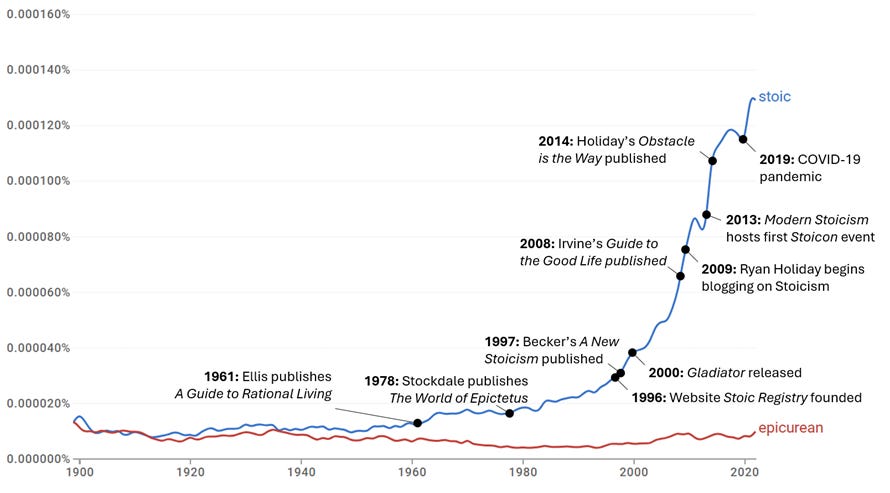
In the chart above, I have also plotted “Epicurean” as a control case (in ancient Athens, the Epicureans were rivals to the Stoics). What we see are noticeable bubbles of Stoic interest around the 1960s and 1970s, beginning with Albert Ellis’s A Guide to Rational Living—more on him later—and continuing with James Stockdale’s campaign. But the true surge dwarfs those earlier perturbations when, in the mid-90s, the curve bends sharply upward.
What caused this turn? A simplistic answer is “the internet.” While the Stoics have always attracted the occasional wisdom-seeker, the internet has allowed these enthusiasts to meet in ways previously impossible. In this telling, philosophy geeks converged in forums, blogs, and early social platforms, creating a network effect with steady, compounding growth—enough for the self‑help industry to smell a commercial opportunity. From there, it has been off to the races.
However, monocausal explanations are almost always wrong, especially when shoehorned into complex social phenomena. Convenient answers obscure key contributors. For example, many ideas are marketed well, yet few have lied so dormant for so long as Stoicism only to burst onto the scene so dramatically. There might be some other cultural force at work, and if we look closely, we may find a clue. For example: why do you suppose that interest spikes during the COVID-19 pandemic?
The Mental Health Crisis is Real
We cannot properly understand the rise of popular Stoicism apart from the prolonged and widespread decline in mental health that defines our era.1
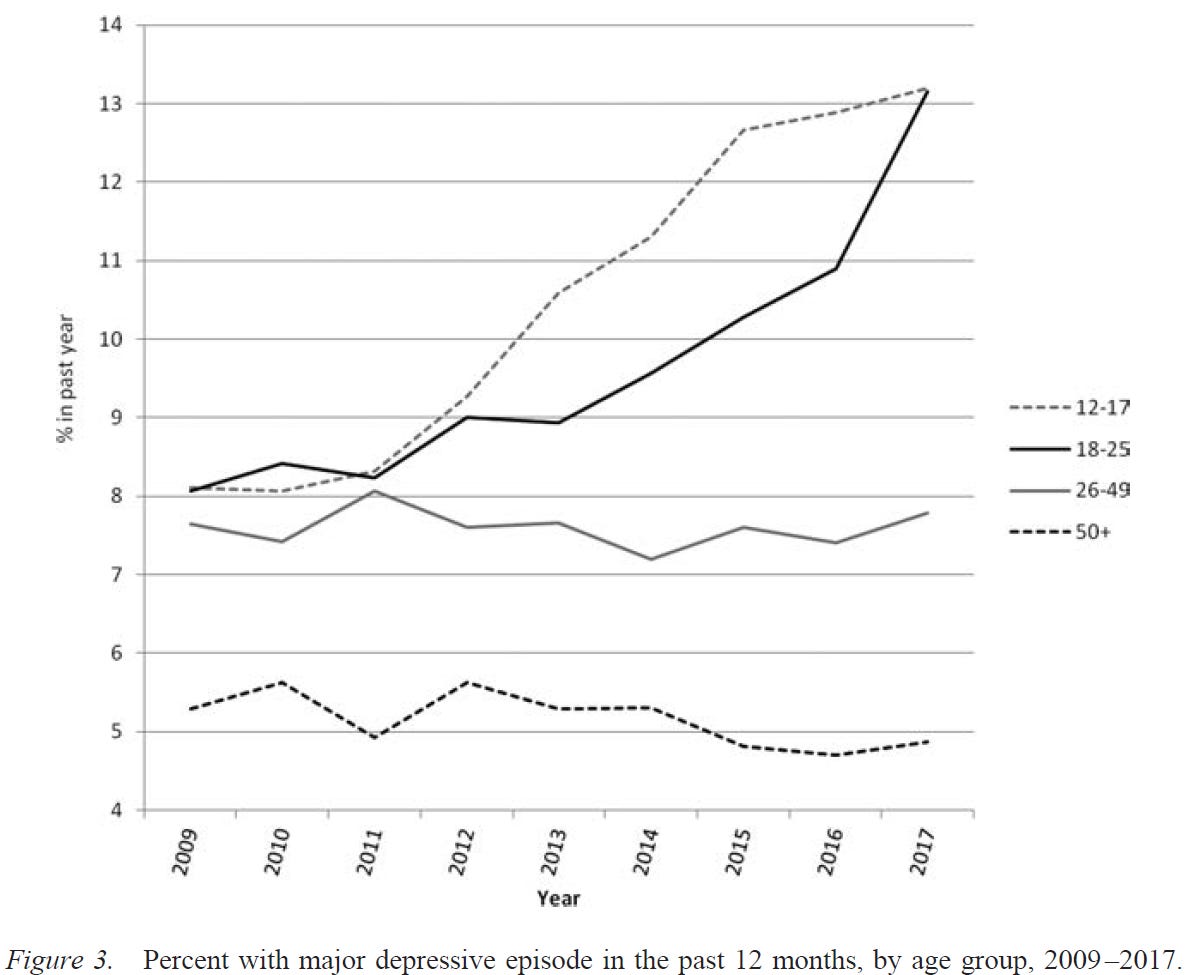
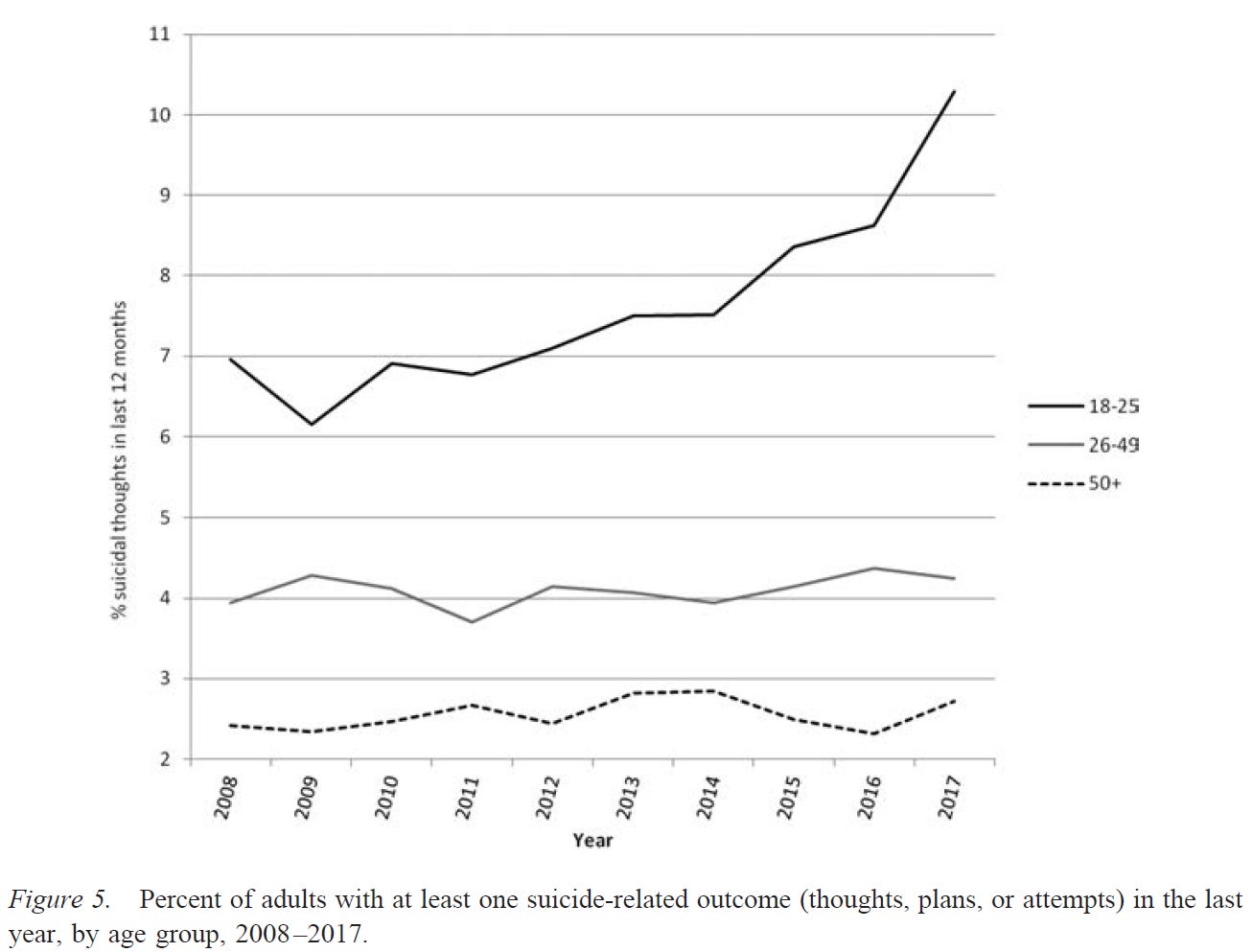
Over the past two decades, multiple large‑scale studies have documented a sharp and sustained rise in psychological distress among young people the world over. The charts above illustrate a 52 percent rise in major depressive symptoms among American adolescents (2005–2017) and 63 percent rise among young adults (2009–2017). Suicide‑related outcomes also increased 47 percent among young adults (2008–2017), while serious psychological distress rose 71 percent over roughly the same period.2 Though derived from a single large meta‑analysis, these figures synthesize a broader body of research pointing in the same direction.
Sadly, these statistics are rarely surprising to those who work around young people, among whom the language of depression became mainstream a while ago. The causes, however, remain hotly contested. Explanations abound—cultural, technological, economic, familial, political—with little agreement among experts, much less the commentariat, on how to weigh them.3 That said, “screen time” and social media activity are widely cited as major contributing factors.4
To say these trends are problematic for national security would be an understatement. We can table the messier sociopolitical implications; let us just consider the basic problem of manning a military. For example, in the United States, the share of youth eligible for military service without a waiver fell from 29 percent in 2013 to 23 percent in 2020, with mental health being the fastest-growing driver of that decline.5 Diagnosable disorders are not the only consequences of the technology environment; for many youth it has normalized a solitary, individualistic lifestyle and slowed the transition into adulthood—a postponement of traditional milestones charitably called the “slow‑life strategy” by leading researchers.6
Military trainers, then, increasingly must not only prepare recruits for their occupational duties but must also nurture emotional maturity and basic life competencies previously acquired in adolescence. Once that work is done, however, the distress factors reemerge as degraded resilience in those fully trained and serving. To wit, the incidence of diagnosed mental health disorders rose nearly 40 percent between 2019 and 2023, and such conditions now account for the largest share of hospitalization days across the force.7
I must emphasize I am not a mental health professional. I present these data as a warfighter whose responsibilities often involve holding a team together while hemorrhaging personnel to the medical system. It is just as easy to oversimplify these issues as it is tempting to indulge in armchair diagnoses, pet theories and the naming of bogeymen. What can be said without editorializing is this: the data show rising trends of anxiety, depression, and psychological distress among younger cohorts. It is harder than it was in previous generations to find medically qualified recruits, and once they have been recruited and trained, it is harder to keep them fit for full duty. Suicide risk looms over every associated personnel decision. For military professionals, this is our lived reality, whatever one might think about the causes.
Returning to the rise of popular Stoicism, I propose a triangular dynamic involving technology and the mental health crisis. First, the emergence of internet culture and social media enabled niche intellectual communities—such as philosophy readers—to find one another and grow. Second, that same digital environment has incubated a plague of anxiety and depression, only a fraction of which is recorded in medical data. Third, anxiety and depression have driven sufferers to seek stabilizing frameworks, a task for which popular Stoicism is particularly attractive. Secular yet religion-friendly with no institutional barriers, it pairs a formula for human flourishing with ancient gravitas in a package optimized for digital travel.
As we are facing a crisis of emotional regulation, it is unsurprising that a philosophy built around contentment with reality as it is would gain traction. But if the theory above is accurate, an important question is still unaddressed: Why Stoicism in particular? Why not Epicureanism, Neoplatonism, or some other ancient school—or even a more modern therapeutic invention? What is it about Stoicism that uniquely suits this cultural moment?
Stoicism as Self-Therapy
Today, when a servicemember is referred to the medical system for mental health treatment, the modality they will most likely encounter is cognitive‑behavioral in orientation—most commonly Cognitive Behavioral Therapy (CBT) or one of its closely related derivatives.8 In practical terms, this means that many who enter therapy are taught structured methods for examining their own judgments, identifying unproductive ruminations, and learning to distinguish between what is within their control and what is not. They are trained to reassess underlying assumptions and to respond to stress deliberately rather than reactively.
If that sounds a lot like Stoicism, the resemblance is not incidental. The founders of modern cognitive therapy acknowledged the connection openly. Albert Ellis, who developed Rational Emotive Behavior Therapy in the 1950s, frequently cited Epictetus’ observation that we are disturbed not by events but by our judgments about them as a foundational insight. Aaron Beck, whose work became known as Cognitive Therapy and later merged into what we now call CBT, likewise focused on identifying and correcting “automatic thoughts.” He would later acknowledge the Stoics as early champions of the same concept.9
While CBT was already established practice by the time James Stockdale began speaking publicly about Epictetus, there is little evidence that he had these intellectual connections in mind. His emphasis was more squarely on moral virtue under severe stress. More importantly, there was no depression epidemic; psychotherapy was uncommon, private, and heavily stigmatized. That is less the case today.
Neither Beck nor Ellis was attempting to revive an ancient school of philosophy, although Ellis’s 1961 self-help hit A Guide to Rational Living set the stage for the Stoics’ return to popularity. Both men were clinicians, committed to building structured, testable treatments grounded in observation and empirical validation. Yet in translating philosophical insight to therapeutic method, complete with technical vocabulary, treatment protocols, and outcome studies, they gave modern form to ideas the Stoics had articulated nearly two millennia earlier.
The parallels extend well beyond the methods of either Epictetus or Albert Ellis. Across the therapeutic tradition following from the latter’s work, one finds recurring structural similarities to canonically Stoic practices: the mediation of emotion by belief, the disciplined examination of impressions, the deliberate rehearsal of adversity, and clarifying the distinction between what lies within one’s power and what is beyond it—to name a few. What modern therapists describe as interventions or protocols, the Stoics would simply describe as how one ought to think.
And just as Stoicism aims to equip a person for self‑governance, the effective therapist aims to habituate techniques of self-therapy rather than create dependency on the counselor. Cicero, an ancient admirer of the Stoics, captures the spirit perfectly: “There surely exists a medicine for the soul—it is philosophy. We must seek its help not from the outside, as we do with bodily ailments. We must exert ourselves intensely, deploying all our efforts and powers, so that we can act as our own healers.”10
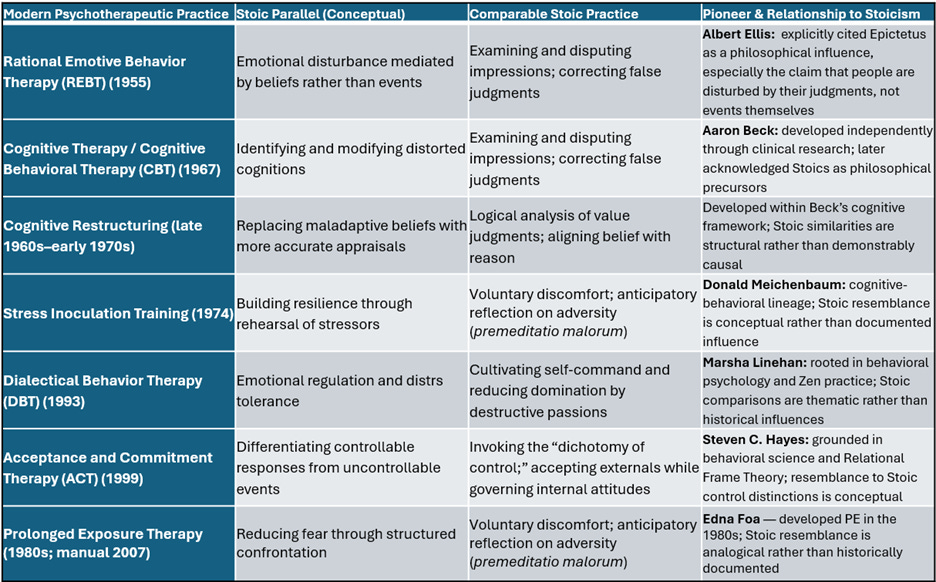
We should be clear that modern psychotherapists are not simply “doing Stoicism.” Contemporary therapeutic practices are the product of decades of empirically validated research, subjected to controlled trials, statistical analysis, and ongoing refinement. They are scientifically rigorous in a way that no philosopher of antiquity would have conceived. Likewise the Stoics, for all their psychological insight, did rely on models of cognition and physiology that belong in a pre‑scientific world.
As a form of psychotherapy, then, Stoicism is more like a natural remedy. For example, indigenous peoples discovered that chewing willow bark could relieve pain, and that boiling it into a tea could reduce fever, millennia before anyone knew why it worked or identified the active ingredient: salicylic acid, which we now synthesize as aspirin. In similar fashion, the Stoics intuited durable principles about belief, emotion, and resilience centuries before psychology could describe those processes in clinical terms. But just as no responsible physician would prescribe willow bark in place of aspirin, no responsible clinician would prescribe Stoicism in lieu of psychotherapy—when needed. That would be malpractice.
Where Stoicism shows medical promise, especially in a military setting, is not as a substitute for treatment but as a preventive. It aims to place the tools of the therapist in the pocket of the would-be patient before crisis occurs, such that therapy might never become necessary in the first place.
Resilience is Character is Resilience
The psychological element, particularly its effectiveness as such, is what separates Stoicism from the many frameworks promising to make one a better person. That is the value proposition—the “what’s in it for me”—which keeps modern, attention-short users reading. The resulting trend is a culturally emergent adaptive response to the cognitive environment we have created. But philosophy is much more than self‑therapy, and Stoicism, in particular, has always emphasized the interdependence of mindset, action, and character.
People of faith have found Stoicism helps them think more clearly about what’s important. Stockdale, a sophisticated Christian, exemplified this, and recent works such as Kevin Vost’s The Porch and the Cross and Brittany Polat’s Jesus and Stoicism articulate the resonance neatly. On the other hand, for those uninterested in faith, Stoicism nonetheless cultivates its healthiest purported habits of mind: gratitude, selflessness, humility, accountability, and indifference to material adornments. These qualities—moral qualities—do not just complement but are mutually reinforcing with the therapeutic aspects of Stoicism, comprising a system far sturdier than moralizing or therapeutic training alone.
Of all my writing on Stoicism, the throughline is this: If any existing framework merits the label “warrior philosophy,” Stoicism is it. It encourages precisely the qualities one desires in a warrior with seriousness and coherence. At the same time, it is hostile to panic, anger, vanity, victimhood, and other moral turpitudes. This is what James Stockdale understood through lived experience, and why he thought it important enough to teach it, against all professional norms.
Now consider prevention. Suppose a medical laboratory developed a compound that measurably reduced vulnerability to anxiety and depression. Such a “mental health vaccine” would represent the therapeutic dimension of Stoic practice. But imagine further that it also promised increased composure under stress, strengthened habits of self-discipline, and reinforced ethical restraint. As a military institution concerned with readiness, professionalism, and integrity, how would we regard such a product?
What I Actually Recommend
The Stoicism trend is good for the military because it is psychologically aligned with modern therapy, preventative in orientation, and conducive to warrior-ideal character. And yet despite the work I’ve done to promote it, I am ambivalent about formally teaching it in the military. I’m not a training expert, so I’d need to know more what it would look like before weighing in with confidence.
If forced to provide a recommendation today, I would likely advise against incorporating Stoicism to general training curricula. Senior national security professionals have advocated doing so, and small‑scale efforts have been tried. I simply doubt that philosophy remains philosophy when bureaucratized, and I suspect it would create more antibodies than warrior-philosophers. If it belongs anywhere, it is in small groups or tight units where it can be engaged voluntarily and seriously. It works best as an underground thing.
The purpose of this article, then, is to say that the rise of popular Stoicism is cause neither for irritation nor alarm. I believe it is beneficial; grating as the memes and shortform videos may be, these dumbed-down entry points can do little violence to a 2000-year-old philosophy, as misrepresentations crumble quickly on contact with primary sources. At the very least, popular Stoicism is far more benign than the trends it counters. For military institutions, then, I recommend calmly letting it be, and for individual leaders, I recommend investigating it personally if not already done. One can’t do better than the Discourses of Epictetus, which is what Stockdale favored.
Humans occasionally create conditions that diminish quality of life until we learn to adapt to them. The Industrial Revolution brought unbelievable wealth alongside unbreathable air and children in coal mines. We eventually discovered how to self-regulate. Our own modern successes, likewise, have yielded a mental health epidemic atop a preexisting obesity epidemic. We are still adjusting to the world we have built.
Seen in this light, Stoicism looks less like a fad and more like part of the adaptation: a recovery of discipline, restraint, resilience and moral responsibility suited to evolving times. It is not perfect and not a cure‑all. But it is a step in the right direction.
Thanks for reading. If this was useful to you, you might be interested in my book, Stoicism as a Warrior Philosophy: Insights on the Morality of Military Service.
[1] Veterans will note that I have not included data on PTSD; although often comorbid with anxiety and depression, it raises distinct issues beyond the scope of this argument, which supports but stands independent of veteran care. Suffice it to say, those suffering from PTSD would likely benefit from studying the Stoics as anyone might, yet no intellectual framework is a substitute for professional treatment.
[2] Jean M. Twenge, A. Bell Cooper, Thomas E. Joiner, Mary E. Duffy, and Sarah G. Binau, “Age, Period, and Cohort Trends in Mood Disorder Indicators and Suicide‑Related Outcomes in a Nationally Representative Dataset, 2005–2017,” Journal of Abnormal Psychology 128, no. 3 (2019): 185–199.
[3] Proposed factors range from heightened mental health awareness and diminished stigma to growing social isolation, expanded digital media consumption, and worsening physical maladies such as obesity, nutritional deficits, inadequate sleep, and limited physical activity. See Mojtabai R, Olfson M (2020). National trends in mental health care for US adolescents. JAMA Psychiatry, 77(7), 703–714.
[4] Twenge, J. M., Joiner, T. E., Rogers, M. L., & Martin, G. N. (2019). Increases in depressive symptoms, suicide-related outcomes, and suicide rates among U.S. adolescents after 2010 and links to increased new media screen time. Journal of Abnormal Psychology, 128(3), 185–199.
[5] Obesity remains the leading disqualifier. Department of Defense, Office of People Analytics (OPA). Qualified Military Available (QMA) Technical Report. OPA Report No. 2022-085. Joint Advertising, Market Research & Studies. March 2022.
[6] Jean M. Twenge, Generations: The Real Differences Between Gen Z, Millennials, Gen X, Boomers, and Silents—and What They Mean for America’ Future (New York: Atria Books, 2023), 6-18, 513.
[7] Department of Defense, Armed Forces Health Surveillance Division, “Update: Diagnoses of Mental Health Disorders Among Active Component U.S. Armed Forces, 2019–2023,” Medical Surveillance Monthly Report, December 1, 2024, https://www.health.mil/News/Articles/2024/12/01/MSMR-Mental-Health-Update-2024; Department of Defense, Armed Forces Health Surveillance Division, “Absolute and Relative Morbidity Burdens Attributable to Various Illnesses and Injuries Among Active Component Members of the U.S. Armed Forces, 2023,” Medical Surveillance Monthly Report, June 1, 2024, https://www.health.mil/news/articles/2024/06/01/msmr-health-care-burden-active-component.
[8] David, Daniel, Ioana Cristea, and Stefan G. Hofmann. “Why Cognitive Behavioral Therapy Is the Current Gold Standard of Psychotherapy.” Frontiers in Psychiatry 9 (2018): Article 4.
[9] Donald Robertson, The Philosophy of Cognitive-Behavioural Therapy (CBT): Stoic Philosophy as Rational and Cognitive Psychotherapy (London: Karnac, 2010), 3–9.
[10] Cicero, Tusculan Disputations 3.3 trans. Curtius. Italics mine.
 William C. Spears
Leave a comment